Sunday, 1 March 2015

2015 Withnail at Uncle Monty's Dates Announced! Plus, Queen Victoria RIP...


Danny and Monty together again for the first time! Photo from Picnic Cinema.

The news just in: Picnic Cinema have announced their dates for the insanely popular annual screenings of a certain film in a certain place: Withnail and I will be shown at Crow Crag, aka Sleddale Hall in Cumbria, on Friday 26 and Saturday 27 June 2015. The tickets will go on sale soon (just 100 for each night), and the best (only?) way to give yourself a chance of nabbing one is to sign up of Picnic Cinema's email notification list here. You can have a look at what it was like to attend this wonderful event last year here. It's highly recommended.

Changing the subject entirely, collectors of rare Victoriana might want to have a look at a rather lovely, and beautifully preserved Queen Victoria In Memoriam morocco leather bound (and boxed) Book of Common Prayer Withnail Books currently has on eBay (just click the link top right on this page to see this and a few other select goodies currently for sale).

Here are some photos, with more blurb below for those who fancy making an offer (and while it is a hefty asking price, do feel free to make an offer if it's up your alley... the worse that will happen is that I'll say no!)


Copies of this beautiful Queen Victoria memorial edition of The Book of Common Prayer, with Hymns Ancient and Modern very rarely come up for sale. One of the few references to another, long-sold copy online is here.

This is hand-numbered copy 131 from the 500 copy De Luxe edition, and is in remarkable condition.
The original outer presentation box (16 x 12 x 5.5cm) has a bit of sun fade and a cracked corner, but the baize-lined interior  is still doing its job of protecting the fitted leather case inside. The case has a few light marks, but is overall in very good+ condition. The solid silver button clasp is datemarked for Birmingham 1900, and was made by Charles Penny Brown. The interior is lined in cream moiré silk. The book inside is in, I hesitate to say it, near fine condition: it looks to have been barely handled. There are a couple of very light marks to the upper board, only noticeable if you really look for them, but as with the case, it's difficult to tell if this is actually a 'mark', or just variations in the original leather colour. The gilt page edges are still bright (a rather lovely detail is how the page edges are twin-toned, and turn to Royal Purple when looked at edge on). The book has gilt interior board edges and silk endpapers, and two silk page markers.

The title pages to the various sections read:
Special Forms of Service in Commemoration of Her Late Majesty Queen Victoria of Blessed and Glorious Memory.
To Be Used in All Churches and Chapels in England and Wales and in the Town of Berwick-Upon-Tweed.
Either on the Day of the Funeral, or on the most convenient Day within the Octave.
The Book of Common Prayer and Administration of The Sacraments, and Other Rites and Ceremonies of the Church, According to the Use of The Church of England; Together With The Psalter or Psalms of David,… And The Form and Manner of Making, Ordaining and Consecrating of Bishops, Priests, And Deacons
 Hymns Acient and Modern For The Use in The Services of the Church.
Complete Edition.


Saturday, 21 February 2015

Read that Lost Sherlock Holmes Story, And Why It's Not Really Sherlock Holmes At All...

What a treat to wake up to the news that a previously lost, and indeed unrecorded Sherlock Holmes story has been rediscovered. Yesterday The Scotsman had the news, which has since gone worldwide, but I've yet to see much discussion of its actual content.


Whether or not it's actually written by Conan Doyle himself (and there's no way we're ever going to know definitively, but the evidence would suggest it probably is from his hand), what is clear is that this new 'Sherlock Holmes story' isn't really a story... and it doesn't feature Sherlock Holmes.

Well, not the 'real' Sherlock Holmes, anyway. The 'author' of the piece – an unnamed journalist on a deadline, not John Watson – freely admits that his 'interview' with Sherlock Holmes comes via 'The Faculty of Imagination'. Even without this admission, the fact that this Holmes is an imposter is abundantly clear from the several errors the careless 'author' makes.

It would need a finer Holmesian than I to identify them all, but for starters:

This Holmes, apparently, lives in Sloan Street. He owns a complete set of Macaulay's works, quotes The Lays of Ancient Rome, and often discusses politics and 'the fiscal question' with Watson.

This is surely not the inhabitant of 221B Baker Street described by his faithful Boswell as having:
Knowledge of Literature: Nil
Knowledge of Politics: Feeble

I think these fun 'easter eggs' for the keen Holmes fan to spot adds to the evidence that Doyle himself was indeed the author. There's actually lots of references, both Holmesian and political, for Doyle biographers to get their collective teeth into here. The game is afoot...

It's a fun piece in its own right though, so here it is in its entirety:


'Sherlock Holmes: Discovering the Border Burghs and, by deduction, the Brig Bazaar'

'We've had enough of old romancists and the men of travel, said the Editor, as he blue-pencilled his copy, and made arrangements for the great Saturday edition of the Bazaar Book. 'We want something up-to-date. Why not have a word from "Sherlock Holmes"?'

Editors have only to speak and it is done, at least, they think so. 'Sherlock Holmes!' As well talk of interviewing the Man in the Moon. But it does not do to tell Editors all that you think. I had no objections whatever, I assured the Editor, to buttonhole 'Sherlock Holmes,' but to do so I should have to go to London.

'London!' scornfully sniffed the Great Man. 'And you profess to be a journalist? Have you never heard of the telegraph, the telephone, or the phonograph? Go to London! And are you not aware that all journalists are supposed to be qualified members of the Institute of Fiction, and to be qualified to make use of the Faculty of Imagination? By the use of the latter men have been interviewed, who were hundreds of miles away; some have been "interviewed" without either knowledge or consent. See that you have a topical article ready for the press for Saturday. Good day'.'

I was dismissed and had to find copy by hook or by crook. Well, the Faculty of Imagination might be worth a trial.

The familiar house in Sloan Street met my bewildered gaze. The door was shut, the blinds drawn. I entered; doors are no barrier to one who uses the Faculty of Imagination. The soft light from an electric bulb flooded the room. 'Sherlock Holmes' sits by the side of the table; Dr Watson is on his feet about to leave for the night. Sherlock Holmes, as has lately been shown by a prominent journal, is a pronounced Free Trader. Dr Watson is a mild Protectionist, who would take his gruelling behind a Martello tower, as Lord Goschen wittily put it, but not 'lying down!' The twain had just finished a stiff argument on Fiscal policy. Holmes loq,-

'And when shall I see you again, Watson? The inquiry into the "Mysteries of the Secret Cabinet" will be continued in Edinburgh on Saturday. Do you mind a run down to Scotland? You would get some capital data which you might turn to good account later.'

'I am very sorry,' replied Dr Watson, 'I should have liked to have gone with you, but a prior engagement prevents me. I will, however, have the pleasure of being in kindly Scottish company that day. I, also, am going to Scotland.'

'Ah! Then you are going to the Border country at that time?'

'How do you know that?'

'My dear Watson, it's all a matter of deduction.'

'Will you explain?'

'Well, when a man becomes absorbed in a certain theme, the murder will out some day. In many discussions you and I have on the fiscal question from time to time I have not failed to notice that you have taken up an attitude antagonistic to a certain school of thought, and on several occasions you have commented on the passing of "so-called" reforms, as you describe them, which you say were not the result of a spontaneous movement from or by the people, but solely due to the pressure of the Manchester School of politicians appealing to the mob. One of these allusions you made a peculiar reference to "Huz an' Mainchester" who had "turned the world upside down." The word "Huz" stuck to me, but after consulting many authors without learning anything as to the source of the word, I one day in reading a provincial paper noticed the same expression, which the writer said was descriptive of the way Hawick people looked at the progress of Reform. "Huz an' Mainchester' led the way. So, thought I, Watson has a knowledge of Hawick. I was still further confirmed in this idea by hearing you in several absent moments crooning a weird song of the Norwegian God Thor. Again I made enquires, and writing to a friend in the South country I procured a copy of "Teribus." So, I reasoned, so - there's something in the air! What attraction has Hawick for Watson?'

'Wonderful,' Watson said, 'and -- '

'Yes, and when you characterised the action of the German Government in seeking to hamper Canadian trade by raising her tariff wall against her, as a case of "Sour Plums," and again in a drawing room asked a mutual lady friend to sing you that fine old song, "Braw, braw lads," I was curious enough to look up the old ballad, and finding it had reference to a small town near to Hawick, I began to see a ray of daylight. Hawick had a place in your mind; likewise so had Galashiels - so much was apparent. The question to be decided was why?'

'So far so good. And -- '

'Later still the plot deepened. Why, when I was retailing to you the steps that led up to the arrest of the Norwood builder by the impression of his thumb, I found a very great surprise that you were not listening at all to my reasoning, but were lilting a very sweet - a very sweet tune, Watson - "The Flowers of the Forest;" then I in turn consulted an authority on the subject, and found that that lovely if tragic song had a special reference to Selkirk. And you remember, Watson, how very enthusiastic you grew all of a sudden on the subject of Common-Ridings, and how much you studied the history of James IV., with special reference to Flodden Field. All these things speak, Watson, to the orderly brain of a thinker. Hawick, Galashiels, and Selkirk. What did the combination mean? I felt I must solve the problem, Watson; so that night when you left me, after we had discussed the "Tragedy of a Divided House," I ordered in a ton of tobacco, wrapped my cloak about me, and spent the night in thought. When you came round in the morning the problem was solved. I could not on the accumulative evidence but come to the conclusion that you contemplated another Parliamentary contest. Watson, you have the Border Burghs in your eye!'

'In my heart, Holmes,' said Watson.

'And where do you travel to on Saturday, Watson?'

'I am going to Selkirk; I have an engagement there to open a Bazaar.'

'Is it in aide of a Bridge, Watson?'

'Yes,' replied Watson in surprise; 'but how do you know? I have never mentioned the matter to you.'

'By word, no; but by your action you have revealed the bent of your mind.'

'Impossible!'

'Let me explain. A week ago you came round to my rooms and asked for a look at "Macaulay's Lays of Ancient Rome." (You know I admire Macaulay's works, and have a full set.) That volume, after a casual look at, you took with you. When you returned it a day or two later I noticed it was marked with a slip of paper at the "Lay of Horatius," and I detected a faint pencil mark on the slip noting that the closing stanza was very appropriate. As you know, Watson, the lay is all descriptive of the keeping of a bridge. Let me remind you how nicely you would perorate -

When the goodman mends his armour

And trims his helmet's plume,

When the goodwife's shuttle merrily

Goes flashing through the loom,

With weeping and with laughter.

Still the story told -

How well Horatius kept the bridge,

In the brave days of old.

Could I, being mortal, help thinking you were bent on some such exploit yourself?'

'Very true!'

'Well, goodbye, Watson; shall be glad of your company after Saturday. Remember Horatius' words when you go to Border Burghs :- "How can man die better than facing fearful odds." But there, these words are only illustrations. Safe journey, and success to the Brig!'

UPDATE: MATTIAS BOSTROM IS CONVINCED THE STORY IS NOT WRITTEN BY DOYLE, AND IT IS A PRETTY STRONG ARGUMENT... BUT STILL NOT DEFINITIVE PROOF EITHER WAY.

Sunday, 15 February 2015

Things That Fall Out Of Books: Where, When and Who Is This?

With a nod to the excellent blogger and bookseller Callum James (from whom I've shamelessly nicked the idea), here a Thing That Fell Out Of A Book; an immaculately preserved full leather copy of the Everyman edition of Melville's Typee, to be precise.

It's a street scene photo, which was evidently originally printed as one half of a postcard, but presumably for a 'private' customer, rather than a postcard on general sale.

From the clothes, my not particularly educated guess is 1920s or 30s rather than 40s, but exactly when, or indeed who or where – I've no idea. The book comes from a local house, but the street certainly doesn't look like anywhere in Penrith to me. I thought it might be somewhere in Europe (that street looks rather wide and leafy, boulevard-style), but then I had a look at that 'B' on the shopfront: from the font I'm pretty certain that's a Boots the chemist... but which branch? 

And why is she carrying what looks like an overcoat when she's already wearing one? Anyone got any more ideas?


Sunday, 8 February 2015

Canine Couture, or, Dogs In Dresses


Leafing through a bound copy of Pearson's Magazine from July to December 1898, I came across this, which I thought definitely deserved to be on the internet:


The text is almost as funny as the pictures: the correspondent, one Robert H. Sherard, becomes more and more incredulous as it goes on. His interviewee is Monsieur Vivier, proprietor of the Galerie D'Orleans, "successor to the Monsieur Ledouble, who was the founder of this curious industry" a full 20 years before.

**************

"We dress dogs [says Monsieur Vivier] for every function of social life. There is, for instance, the visiting costume, which this year has largely been made in box cloth, with leather trimmings, and the dog's initials, name, or coat of arms in gold lettering in one of the corners. A little bunch of artificial flowers, by preference cat's eyes or forget-me-nots, is placed behind the Medicis collar. Then there is the 'at home' suiting, made for the most part of silk, warmly lined; the yachting costume, which is made chiefly in blue serge; and the travelling costume, which is made of Scotch tartan, fitted with two little pockets, one for the dog's handkerchief and the other for his railway ticket."

"The dog's handkerchief, I cried, "and what is that for?"

"What is a handkerchief for?" answered Monsieur Vivier in some surprise. "To wipe his eyes with, if not to wipe his nose. All our coats are fitted with little pockets for handkerchiefs, and no fashionable dog ever goes out without a handkerchief in his pocket. It is a very good line in the outfitting trade. The handkerchiefs are often very luxurious articles, made of fine cambric trimmed with lace and worked in silk with the dog's name or crest. Most dogs take three or four dozen handkerchiefs at a time."

***************

Well, that told Mr Sherard. Fancy doubting the need for a dog's handkerchief.


Sunday, 1 February 2015

Star Wars in Hungary (Slight Return)

Last week's post on the unofficial Hungarian Han Solo novels proved quite popular, so here's an encore: these images have been seen around the net for a while, but they're brilliant, and deserve any excuse to share.

Like their equally hatstand Polish counterparts, the Hungarian posters for the original Star Wars trilogy are dementedly wonderful.

They were painted by Tibor Helenyi, another artist who wouldn't have got on well with the Lucasfilm approvals process ("Well, I just thought I'd redesign Darth Vader, and add some aliens of my own... is that a problem?").

He died last year, and there's a short bio of him here. His other movie posters were fantastic too...


Sunday, 25 January 2015

Han Solo and the Lost Hungarian Legacy


In tests, it has been scientifically proven (probably) that the coolest Star Wars character is not that default answer of callow youths — Boba Fett — but is in fact the scruffy lookin' nerf herder himself, the Corellian smuggler Han Solo.

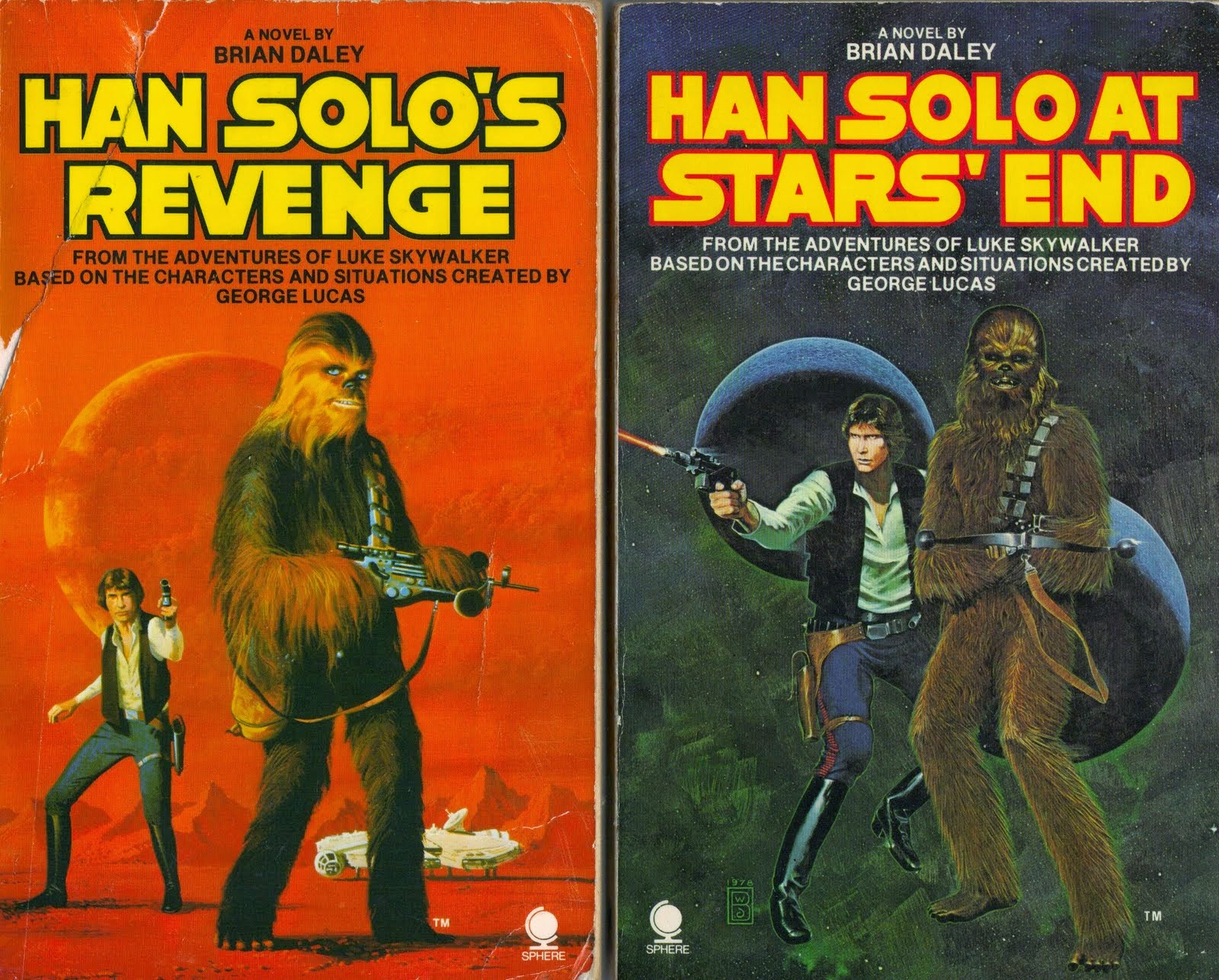
It's not surprising then that, back in the early days of Star Wars spin-offs, a subgenre that has since grown to encompass countless novels, comics and computer games (so many in fact that the new Disney/Lucasfilm recently disassociated themselves from the complex continuity that has grown up, no doubt to make their lives simpler), some of the very first 'original' fiction (only Splinter of the Mind's Eye preceded it) centred around Solo.

Brian Daley's 1979 trilogy consisted of three 'prequel' Han 'n Chewie tales, eagerly consumed by fans looking for 'new' Star Wars in between episodes IV and V. They had great covers:


The books proved popular with fans, and are indeed still in print in a 3-in-1 edition. Fanboy note: the text of this edition restores the original name of Han's droid, BLX-5, known as Bollux. No doubt to avoid tittering, the first UK editions had changed this to Zollux. I promise I'm not making this up.

So what's this Hungarian Legacy then? Well... back in the early 1990s I lived for a while in Budapest. I used to buy cheap knock-off cassettes for my Walkman from stalls outside the railway stations, stalls which also had cheap paperbacks. One morning I saw one of these... (even though my Hungarian was and is non-existent, I had to have it):


A Luke Skywalker-centric Star Wars novel by Alan Dean Foster: yes, it's Splinter of the Mind's Eye, though the Hungarian title is (so google translate tells me) 'Showdown'. I couldn't read it, but I couldn't resist the cover art, which was just off-piste enough to be eye-catching: since when did Luke ever wear a shoulder holster? How the hell did Lucasfilm, well known for their control-freakery when it came to licensed products, ever approve that for publication?

A few weeks later, I saw these, and also bought copies (all long since sold on, alas, before anyone asks):


Yup, it's the Brian Daley trilogy, with an increasingly off-the-leash cover artist (love the headband Chewie is modelling there). The books evidently did well, and had their own 3-in-1 bind-up, with a similarly bonkers cover:


These had to be unlicensed knock-offs, I thought. After all, the Hungarians had form when it came to dodgy Star Wars merchandise.

What I've only just discovered, all these many years later, is that not only was I right, but the cheeky Hungarian publisher, Valhalla, chanced their arm a *lot* further...


That's four (count 'em) original Hungarian Han Solo novels. The titles translate as:

Han Solo Nomad
Han Solo, Imperial Agent
Han Solo and the Bounty Hunter
Han Solo War

Information (in English) on these books is thin on the ground, but after some fairly deep googling I've seen 'Dale Avery' revealed as a pseudonym for the Hungarian writer Zsolt Nyulászi. No one seems to know who 'Ed Fisher' was (other than Carrie Fisher's Dad, but one assumes it wasn't him...). Apparently the books were presented inside as translations of English books! They certainly weren't, so one can only assume that they were effectively unlicensed.

Eventually, one source says, Lucasfilm caught up with Valhalla and 'acquired' the rights to the novels (i.e. threatened to sue them out of existence if they didn't immediately cease and desist).

'Dale Avery' didn't mind though: he'd gone on to publish a standalone sci-fi novel which trumpeted his involvement with Han Solo on the cover. It wasn't anything to do with Star Trek as far as I can ascertain, but that didn't stop the cover artist doing a nice painting of a Romulan Warbird...


The Hungarian Hans remain a bizarre and little-known footnote in the history of Star Wars, but from the looks of this Magyar trading site, it's not impossible to find second hand copies of them.

There are English-speaking fans who are still desperate to read them. As recently as this month (January 2015) this fan site was appealing for translators. Count me in to read 'em if translations do ever see the light of day, though one thing's for sure, they won't be official.

Let's hope they arrive in time for Solo's swan song appearance on screen (spoiler*) this Christmas...


*OK, I don't actually know whether it will be his final appearance or not, but the smart money is on them killing him off at the end of Episode VII. Considering that's what Harrison Ford wanted to happen in Return of the Jedi, I reckon the promise of an heroic exit was what it took to get him back for one more go round...


Sunday, 18 January 2015

Penrith Engraved


There must be literally thousands of different postcards, and before that, engravings of Penrith created over the last couple of hundred years. Here's a quick look at two engravings from the mid-19th century, which are currently in the Little Shop.

The first is of the 'Giant's Grave' in the church yard of St Andrew's, Penrith (learn more about this singular monument here). It's by the renowned topographical illustrator Thomas Allom.


Allom was also an architect, who worked with Sir Charles Barry on the Houses of Parliament, but he was probably best remembered for his illustrations, especially of his travels further afield, to Turkey and China. Here's 'Loading tea junks at Tseen'tang' from the latter trip:


Then there's this somewhat romanticised view (presumably from somewhere up on the Beacon), by P Dewint.


This one was not intended to be 'from life', but created as an illustration to that huge sequence of books that nobody reads these days: the Waverley novels by Scott. A bit of googling turned up this 'review' of the series of prints which were released as a partwork of sorts, 'Landscape Illustrations of the Waverley Novels'.


Having looked at the modern version of that view many a time, I can agree that Dewint and his engraver Edward Finden (a superstar of the engraving world in those days) have indeed executed it in the "sweetest and most skilful manner".

Complete sets of these prints are still available, getting on for 200 years later, but they ain't cheap.